Egocentric vs Exocentric Datasets
A Complete Guide to First- and Third-Person AI Training Data
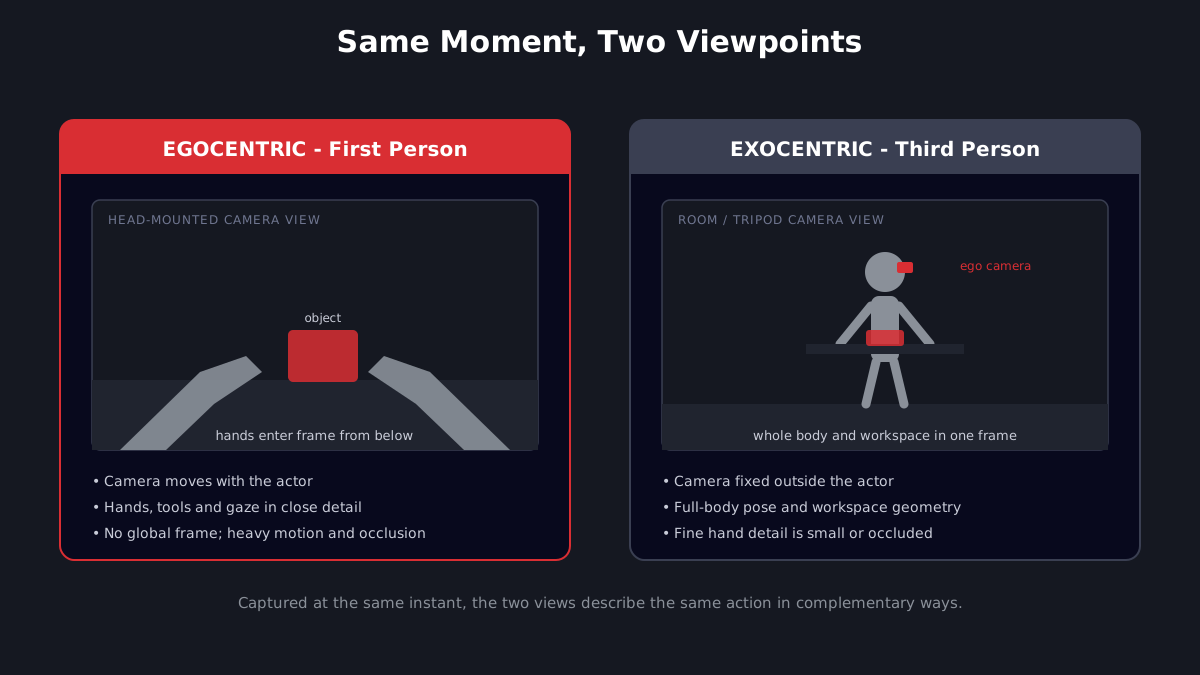
Picture someone repairing a bicycle. Now picture two cameras recording it. One is strapped to the mechanic's head and sees exactly what they see: their hands, the chain, the tool, the grease. The other sits on a tripod across the workshop and sees the whole person, the bike, the bench and the room.
Same repair. Same instant. Two completely different recordings, each capturing something the other misses. That difference is the whole subject of this article.
The first camera produces egocentric data. The second produces exocentric data. As AI moves from labelling photographs to acting in the physical world, the demand for both has grown sharply, and so has the difficulty of collecting them well.
The Definition, Precisely
The distinction rests on one thing: where the camera is.
- Egocentric (first-person) data is captured from a sensor attached to, worn by, or embedded within the agent. The camera moves as the actor moves. Think a GoPro on a helmet, smart glasses, an AR headset, or a camera mounted on a robot.
- Exocentric (third-person) data is captured from a sensor positioned outside the agent, observing them. Think a CCTV camera, a tripod in a studio, or a broadcast camera at a match.
The terms come from cognitive science, where they describe two frames of reference the human brain uses: one anchored to your body, one anchored to the world. Both matter, and you switch between them constantly without noticing.
What Egocentric Captures Well
- Hands, tools and the object being manipulated, in close detail
- Attention and intent, especially when eye gaze is recorded alongside
- The scene changes that follow directly from an action
- Head motion and body dynamics, via IMU
And what makes it hard
Constant motion blur. Objects leaving frame the moment the head turns. Severe self-occlusion, because the hand doing the work hides the thing being worked on. And no stable global frame of reference, since the camera never stops moving.
What Exocentric Captures Well
- Full-body pose and whole-body motion
- Workspace geometry and the actor's position within it
- Interactions between multiple people
- Objects that the actor's own body would occlude
And what makes it hard
The fine detail of a grasp may be a handful of pixels. Intent is invisible, because you cannot see where the person is looking. And a fixed camera has fixed blind spots that the actor will inevitably turn their back on.
Why You Want Both, Captured Together
Read those two lists again and the pattern is hard to miss: each viewpoint's weakness is the other's strength. Ego sees the grasp but not the body. Exo sees the body but not the grasp. Ego knows intent but not position. Exo knows position but not intent.
This is why the most valuable ego/exo datasets are not two separate collections stapled together. They are simultaneous, time-synced captures of the same event. That synchronisation is the entire point, and it is what makes the data expensive.
When every stream shares one clock, any frame in the ego view maps to the exact same instant in every exo view. A model can then learn that this blurry close-up of a hand and that distant figure across the room are the same action, seen twice. Learn that correspondence across enough examples and the model starts to build a representation of the action that is independent of where the camera was standing.
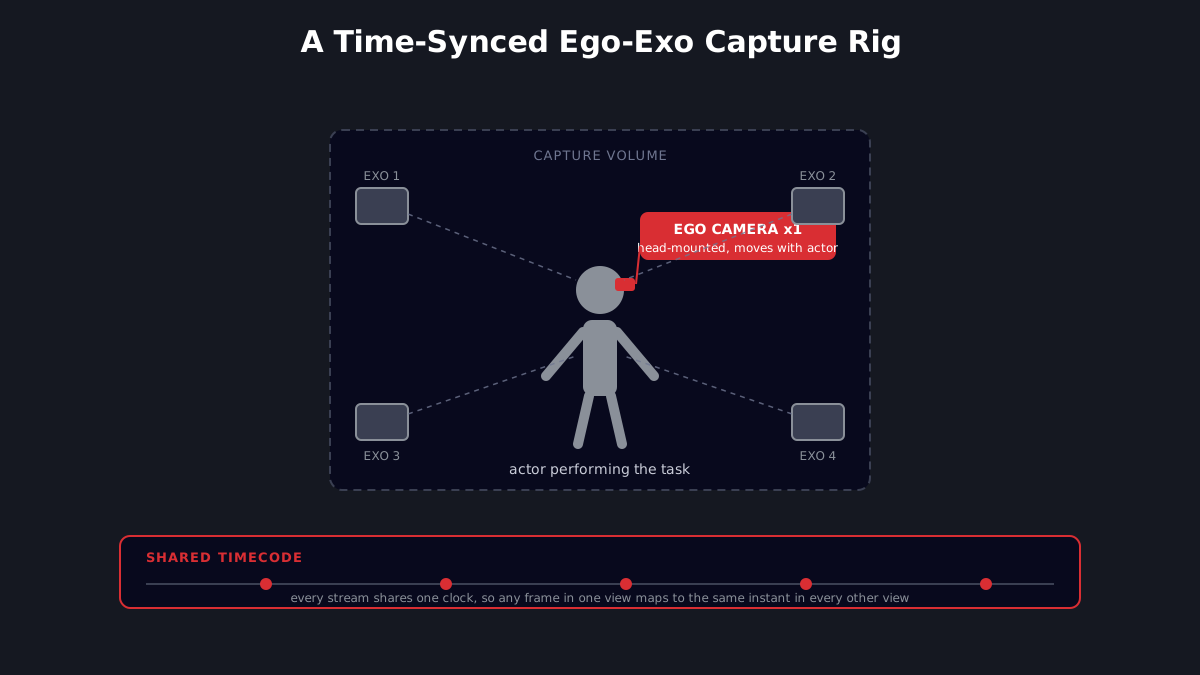
That viewpoint-invariance is not an academic nicety. It is the thing that lets a robot watch a human do something and then do it itself, despite the fact that its cameras are nowhere near where the human's eyes were.
Why This Data Is Collected, and How It Gets Used
For most of computer vision's history, training data was exocentric almost by default, because that is how cameras were pointed: at things, from outside. The shift toward egocentric collection tracks a shift in what we are asking AI to do. A model that captions photographs can sit outside the scene. A model that is meant to act in the world needs to know what acting in the world looks like from the inside.
Four things this data is actually used for:
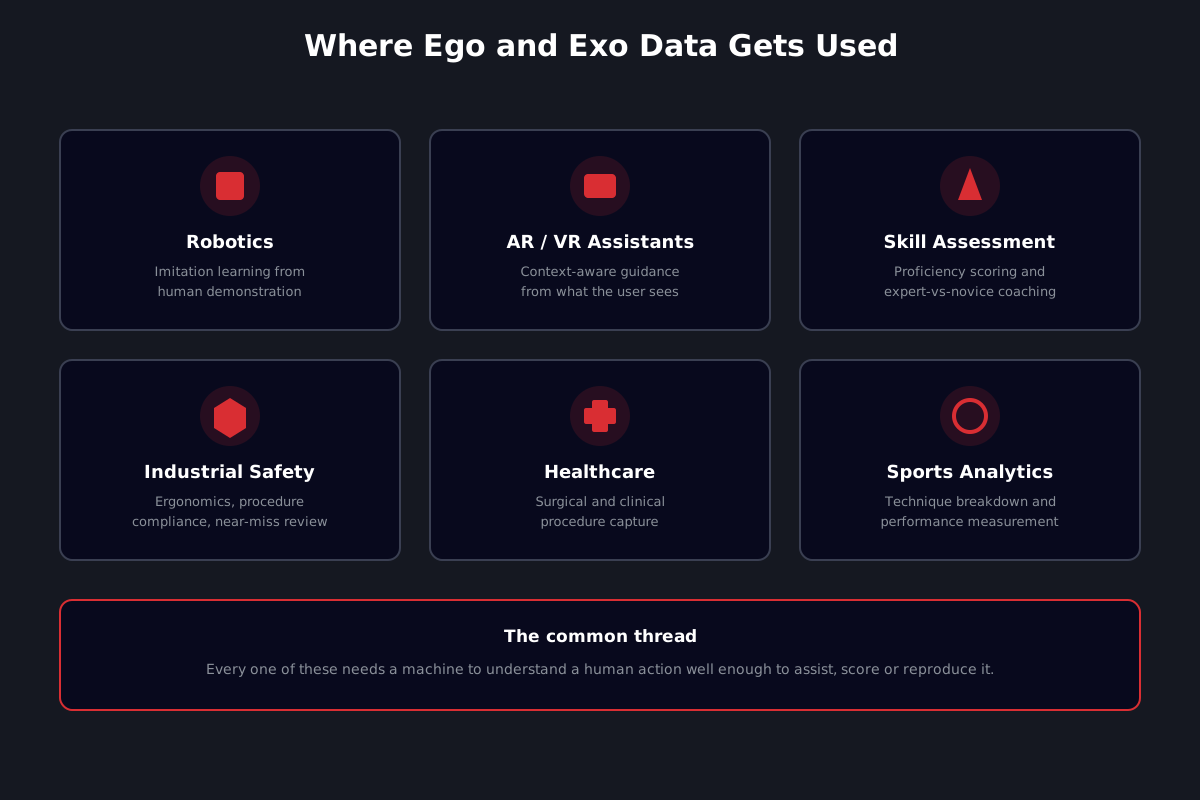
- Teaching robots from human demonstration. Rather than hand-programming a manipulation task, you record humans doing it and let the policy learn. Ego data is the closest available proxy for what a robot's own sensors will see.
- Building assistants that understand context. An AR assistant that can say "you have skipped a step" must first understand what the wearer is looking at and what they just did. That capability is trained on first-person footage of the same task done correctly and incorrectly.
- Assessing skill. Comparing an expert and a novice performing the same task is a natural fit for paired viewpoints. The ego view captures technique; the exo view captures posture and timing. Ego-Exo4D leans into this deliberately, pairing its video with expert commentary from coaches and teachers.
- Cross-view transfer. Exocentric video is abundant, since decades of it already exist. Egocentric video is scarce and costly. A live research thread is learning to transfer knowledge from plentiful exo data to ego tasks, which makes paired data valuable well beyond its own hours.
The Landmark Public Datasets
A handful of research datasets define the field, and they are worth knowing even if you end up collecting your own.
| Dataset | Scale | What makes it notable |
|---|---|---|
| Ego4D | 3,025 hours, 855 camera wearers, 74 locations, 9 countries | The breadth benchmark for first-person daily-life activity. Egocentric only. |
| Ego-Exo4D | 1,286 hours, 740 participants, 13 cities, 123 scenes | Simultaneous, time-synced ego and exo video of skilled activity. Adds multichannel audio, eye gaze, 3D point clouds, camera poses, IMU and expert commentary. Released Dec 2023. |
| EPIC-KITCHENS | Hundreds of hours of unscripted kitchen activity | The long-running fine-grained benchmark for hand-object interaction, with a large verb and noun taxonomy. |
| Project Aria | Research glasses platform | Not a dataset but the capture hardware behind several of them, recording gaze, IMU and spatial data alongside video. |
One caveat worth taking seriously
These datasets exist because participants consented to a specific, reviewed research protocol. A public dataset is not commercial training supply unless the source terms, the consent basis and the downstream licence all permit that use. Check the licence before the data reaches a production model, not after. When the terms do not cover your case, or when your domain simply is not in public data, commissioned collection is the route.
Where Ego and Exo Datasets Get Used
Why Collecting This Data Is Genuinely Hard
Everything above describes data that is valuable. What it does not convey is how much of an ego/exo project is spent not on the interesting parts, but on logistics. The failure modes are consistent enough to list.
- Configuration drift. Fifty collectors, fifty phones, fifty chances for someone to record at the wrong resolution or sampling rate. You usually find out weeks later, when the data lands and half of it does not match the spec.
- Consent at scale. Egocentric capture records the wearer's home, workplace and the people around them. Consent cannot be a folder of scanned PDFs that someone has to reconcile against filenames later. It has to be captured at the moment of recording and bound to the file.
- Metadata inconsistency. If collectors type metadata by hand, you get typos, blanks and creative interpretations of what a field means. Metadata is what makes a dataset queryable; inconsistent metadata quietly reduces its value to near zero.
- Late quality control. QC that runs after collection ends is QC that finds problems when the participants have gone home and the location is no longer available. Re-collection is the single most expensive line item on a data project.
- Data residency. Footage of people's homes and faces, collected across borders, lands squarely inside local data protection law. Where the bytes physically sit is not a detail you can settle afterwards.
- Connectivity. The most interesting collection environments (factories, remote locations, moving vehicles) tend to be the ones with the worst network coverage.
None of these are research problems. They are tooling problems, and they are the reason a collection project that looks straightforward on paper takes three times as long as planned.
HaiCrowd: The AI Data Collection Platform
HaiCrowd is HaiData's AI data collection platform: a mobile app for Android and iOS paired with a web dashboard. It handles collection of Audio, Video, Image, Text, PDF and Email files at scale.
HaiCrowd is not an ego/exo-specific product, and it is worth being straight about that. What it is, is a platform built around exactly the six problems listed above, because those problems are not unique to ego/exo work. They show up on every data collection project that involves more than a handful of people. An ego/exo project just hits them harder.
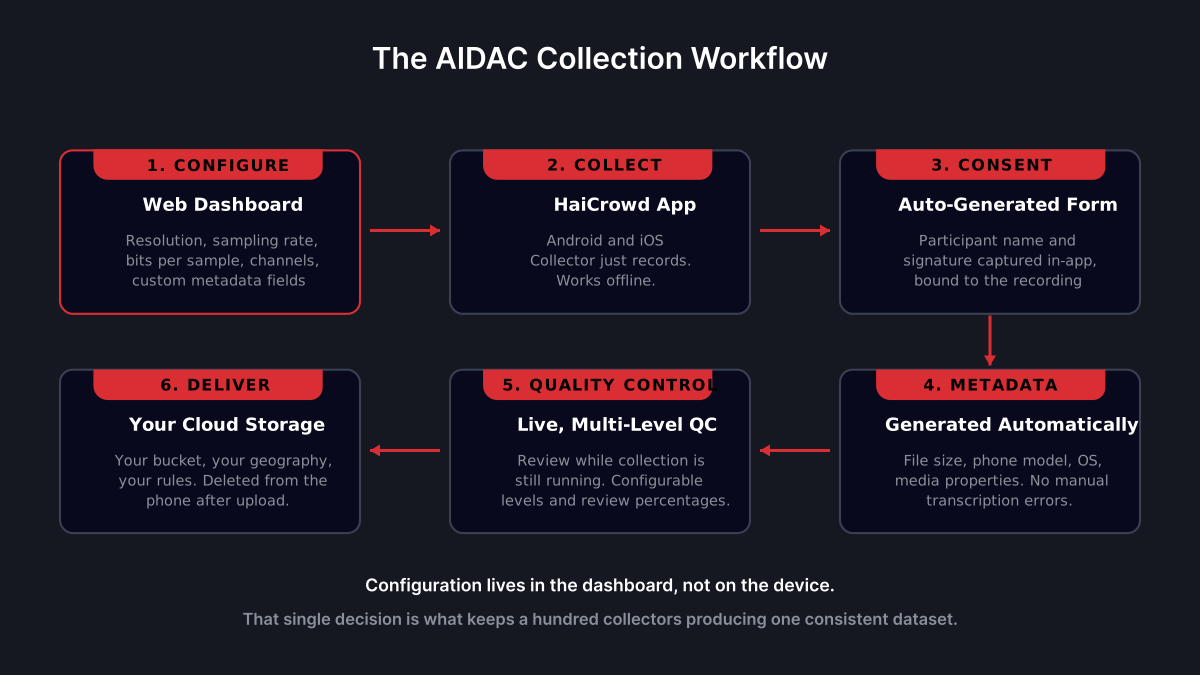
Mapping each problem to what HaiCrowd actually does:
- Configuration drift becomes impossible. Image resolution, audio sampling rate, bits per sample and channel count are all set from the dashboard, not on the device. Collectors never touch them. They open the app and record; the spec is already enforced.
- Consent is generated and bound in-app. Participant name and signature are captured on the device at the time of recording, and the consent form is generated automatically against that session.
- Metadata is generated, not typed. File name and size, phone model, OS version and the media properties are captured automatically. Collectors only fill the custom fields you defined in the dashboard, which removes most of the surface area for human error.
- QC runs live, while collection is still happening. You configure how many QC levels you want, who owns each one (your team, the vendor, or your own org), and what percentage gets reviewed at each level. Problems surface while the participant is still in the room.
- The data goes to your storage, in your geography. Files upload directly from the app to your own cloud storage, wherever local regulation requires it to live, and are permanently deleted from the phone afterwards. There is also a live audit report so you can see upload and QC status as it happens.
- Offline mode handles bad connectivity. The app pre-fetches project details, works with no internet at all, and uploads when the connection returns.
For the audio side of a multimodal capture, HaiCrowd also records multi-party conference calls in WAV with up to four participants, and can save each participant's voice to a separate file, which is a way of solving speaker diarization at source rather than trying to unpick a mixed recording later.
The underlying idea is simple: put the configuration in the dashboard and the enforcement in the tooling, so that scaling from five collectors to five hundred does not scale your quality problems with it.
Annotating Ego and Exo Datasets
Collected footage is raw material. What makes it a training set is the annotation, and ego/exo video is among the more demanding things to annotate well.
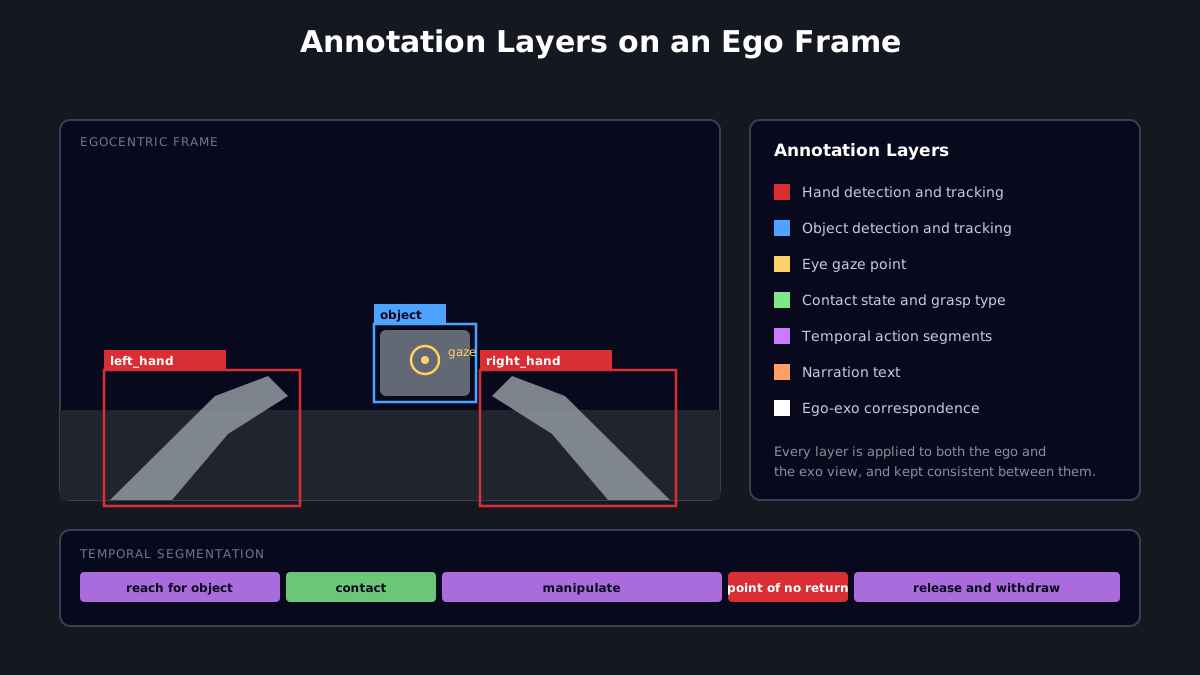
HaiData's annotation teams work across the layers this data needs:
- Temporal action segmentation. Marking the start and end of each action, including the atomic steps and the point-of-no-return moments that fine-grained benchmarks depend on.
- Hand-object interaction. Contact state, grasp type and manipulation phase. This is the layer that carries most of the signal in first-person video, and the layer where annotator judgement matters most.
- Object detection and tracking. Bounding boxes on manipulated objects, held through the occlusion and motion blur that egocentric footage produces constantly.
- Natural language narration. Describing what the person is doing, and where useful, why. Narration quality is what separates a dataset that supports language-conditioned models from one that does not.
- Ego-exo correspondence. Linking the same object and the same action across the two views. This layer exists only in paired data and it is the one that makes paired data worth collecting.
- Gaze and pose. Where recorded, aligning eye gaze and body pose with the visual annotation so the layers agree with each other.
Two things make this work harder than standard video annotation. First, taxonomies get large fast, running to hundreds of verbs and thousands of nouns in datasets like Ego4D, which puts real weight on annotator training and guideline discipline. Second, annotations that are too coarse are close to useless: a label like "moves both hands" is technically correct and tells a model almost nothing. Fine-grained hand-object dynamics are where the value is, and getting there is a function of how well the annotation team understands the domain.
HaiData has been doing annotation work since 2020 from the Nilgiris Hills in India, and the same teams that handle human-in-the-loop and medical annotation work take on ego/exo projects through our Physical AI data annotation services. If you are collecting with HaiCrowd, collection and annotation run as one pipeline rather than two vendors and a handoff.
Frequently Asked Questions
Closing Thought
Ego and exo centric data is not a new idea, but the reason to collect it has changed. We are no longer building models that describe the world from a distance. We are building models that have to operate in it, and that means teaching them what a task looks like from the inside of it, and from the outside, at the same instant.
The research is moving quickly. The hard part, as usual, is not the research. It is getting a thousand hours of consistent, consented, well-labelled footage out of the real world and into a form a model can learn from.
For more information on how HaiCrowd and HaiData's annotation teams could help with your next ego/exo data collection project, please write to info@haidata.ai
Get in touch
For support and query:
Email us at info@haidata.ai
Ainnotate Data Technologies LLP
Prestige Tranquilty,
Budigere Cross,
Bangalore - 560049
Karnataka, India.
Sree Nagammal Bldg.
Manjoor,
The Nilgiris - 643219,
Tamil Nadu, India.




© 2026 | All Rights Reserved | Privacy Policy
HaiData is an AI Data solutions and services organization catering to the AI data needs of various industries. Started with the objective of contributing to "Data Centric AI", HaiData has invested in all aspects of the AI Data value chain - including services, technology and solutions. As an organization committed to providing jobs for technically qualified youth, who chose to work from rural places rather than cities, HaiData provides affordable AI Data related solutions and services to organizations across the world from the villages of Nilgiris hills, in India.