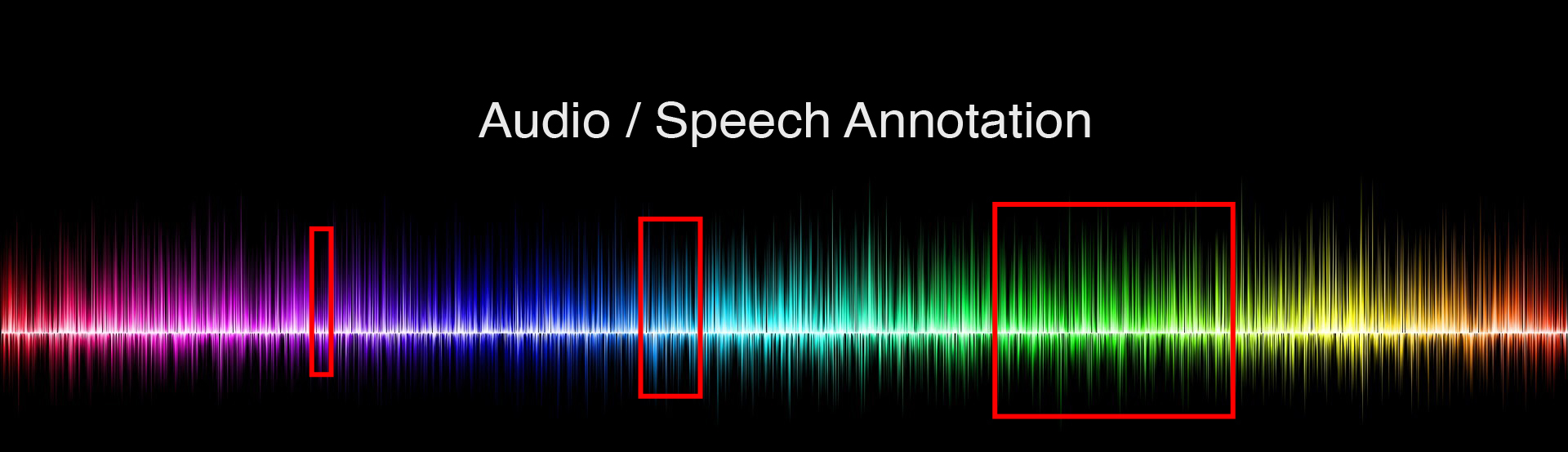
Audio / Speech Annotation
Audio annotation is a process of labeling the audio files with metadata (i.e) additional information, to train the Natural Language Processing (NLP) model. NLP technology is the ability of machines to understand and interpret human language. This technology has led to the development of various AI models such as intelligent chat boxes, virtual assistants and more.
Audio annotation is done by tagging metadata to the audio recording. This is then converted to machine readable format and fed into the NLP system. This approach doesn’t stop with interpreting human voices, it also aids in the study of instruments, animals sounds and so on. Annotating audio files is a supervised process which requires manual work and specialized annotation tools.
Different types of audio annotation are listed below:
- Speech to Text Transcription - It is the process of converting recorded speech to text. Both the words and sounds are carefully annotated along with correct punctuation. It plays a significant role in search engines.
- Audio Classification - This technique aids in the recognition and differentiation of voices by computers. It is crucial for the advancement of voice-activated virtual assistants.
- Music Classification - Using this technique, instruments and their sounds can be tagged or labeled, which is helpful for organizing in music collections.
- Natural Language Utterance - this method annotates human speech with minute details such as intonation, emotions and more. It aids in machine - Human interaction.
- Emotion Recognition - This approach aims in tracking the voices and its additional details such as speech rate, pitch, pitch jumps, voice intensity and more. This could be interpreted to determine emotions such as anger, happiness, sadness, fear, surprise or neutral thereby supporting customer support operations.
- Speech Labeling - Speech labeling is used to create chat boxes that respond to frequent client inquiries.
- Speaker Diarization - it is a process of segmentation or clustering the audio in the recording based on the sound source. It helps in identifying the speakers, addressing the query “Who spoke and when”. This approach greatly helps in understanding the conversation better.

At HaiData, we offer a variety of audio annotation services that suits your NLP model requirements. Contact Us today for a free sample annotation!
Where Audio & Speech Annotation Is Used
Annotated audio is the foundation of modern speech and language AI. Typical application areas include:
- Speech recognition and ASR - transcribing recordings to train and evaluate speech-to-text models.
- Voice assistants and chatbots - intent and utterance labeling for conversational AI.
- Speaker diarization - segmenting who spoke and when for meetings, calls and media.
- Contact centre analytics - emotion and sentiment labeling to support customer service operations.
- Audio and music classification - tagging sounds, instruments and events for search and monitoring.
Why HaiData for Audio Annotation
- Own platform - annotation runs on our in-house HaiCrowd platform (own-cloud) with native iOS and Android apps.
- Multi-layer quality control - multiple levels of human review plus automated QC, including voice duplicate detection, targeting 99% accuracy.
- Consent-first and privacy-aware - GDPR-aligned handling aligned with India's DPDP Act 2023; ISO 27001 certification is in progress (expected 2026).
- Flexible delivery - annotations delivered to your own cloud storage in the formats your pipeline needs.
- Trusted background - NVIDIA Inception Program member and GoodFirms-recognized, based in India and serving clients worldwide.
For large multilingual jobs, pair our team with the semi-automatic audio transcription platform, or explore our full data annotation services.
Frequently Asked Questions
Ready to start? Contact us for a free sample annotation. For tooling background, read our guide to audio annotation tools and dual-channel recording.
Get in touch
For support and query:
Email us at info@haidata.ai
Ainnotate Data Technologies LLP
Prestige Tranquilty,
Budigere Cross,
Bangalore - 560049
Karnataka, India.
Sree Nagammal Bldg.
Manjoor,
The Nilgiris - 643219,
Tamil Nadu, India.


© 2026 | All Rights Reserved | Privacy Policy
HaiData is an AI Data solutions and services organization catering to the AI data needs of various industries. Started with the objective of contributing to "Data Centric AI", HaiData has invested in all aspects of the AI Data value chain - including services, technology and solutions. As an organization committed to providing jobs for technically qualified youth, who chose to work from rural places rather than cities, HaiData provides affordable AI Data related solutions and services to organizations across the world from the villages of Nilgiris hills, in India.