Oriented Bounding box
Annotation is an essential component of the Artificial Intelligence (AI) training process for computer vision systems. An AI system or computer vision model for object detection can be trained by labeling the images in a dataset - this is known as image annotation. One of the most widely used strategies in image annotation is the bounding box technique. This article gives a quick explanation of the Oriented bounding box approach and how it works.
A bounding box is a rectangle used to identify an object in an image. The term "Oriented Bounding Box" also refers to a regular rectangular bounding box that has been rotated to fit object orientation. It helps in figuring out the object's orientation angle when it is rotated or diagonal. The parameters for a rotating rectangle are Xc, Yc, width, height, and orientation angle.
The following are some of the defining attributes of Oriented Bounding Box (OBB):
- Better localization - Allows for the accurate detection of the target object's true size and shape.
- Background isolation - The ability to successfully separate a rotated object from its background.
- Avoid Overlapping - Effectively designate dense objects to avoid overlapping
Oriented Bounding box approach is used in numerous fields. Object recognition in aerial and satellite images is a typical application. A tremendous number of photos are produced by the hundreds of remote sensing satellites that are launched into space. These images' object recognition and localization play a crucial role in the detection of air and ship fleets. Labeling these photographs are difficult because the objects are randomly arranged and come
in a variety of sizes and scales. The major issues with aerial images are
- Small objects - tiny objects are frequently overshadowed by complicated background settings in aerial photos.
- Cluttered arrangement - In aerial photographs, objects such as automobiles and ships are frequently packed close to each other.
- Noisy Images - Due to the variety of disturbances, aerial picture identification calls for a more robust method.
For such instances, objects in the horizontal bounding box are contaminated with background. Oriented bounding boxes could be rotated/ aligned according to an arbitrarily oriented object thus giving tight coverage of the target object. This technique is robust to capture the objects even for the tiny and crowded vehicles.
Annotation of such aerial images enables learning of tasks such as resource detection, environmental monitoring, urban planning, ship and air fleet detection.
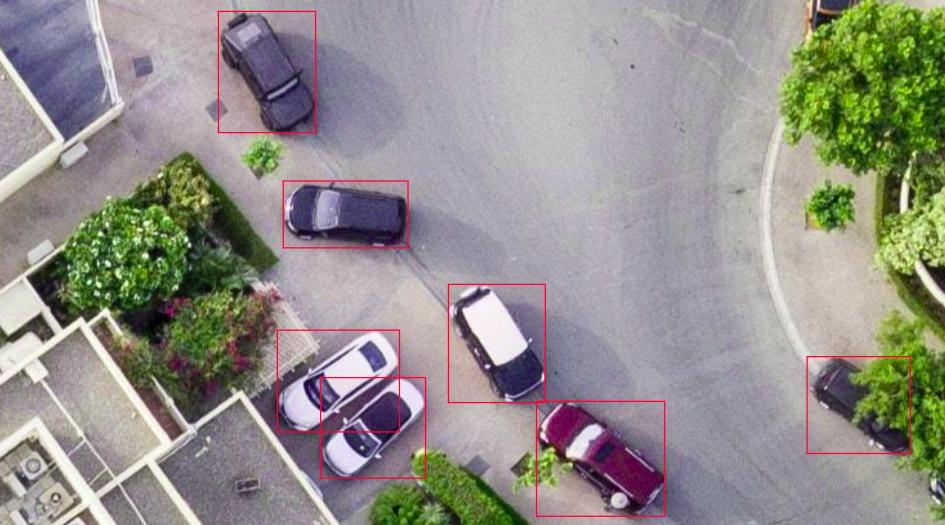
1.a Bounding box
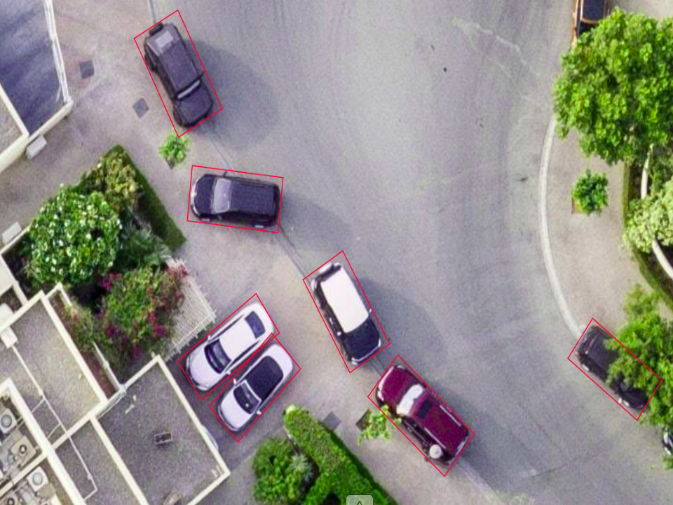
1.b Oriented Bounding box
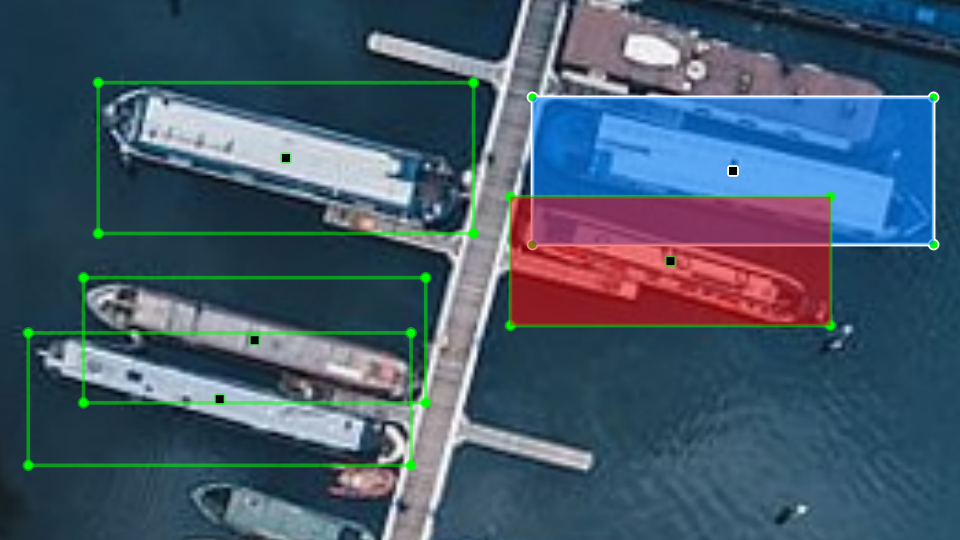
2.a Bounding box
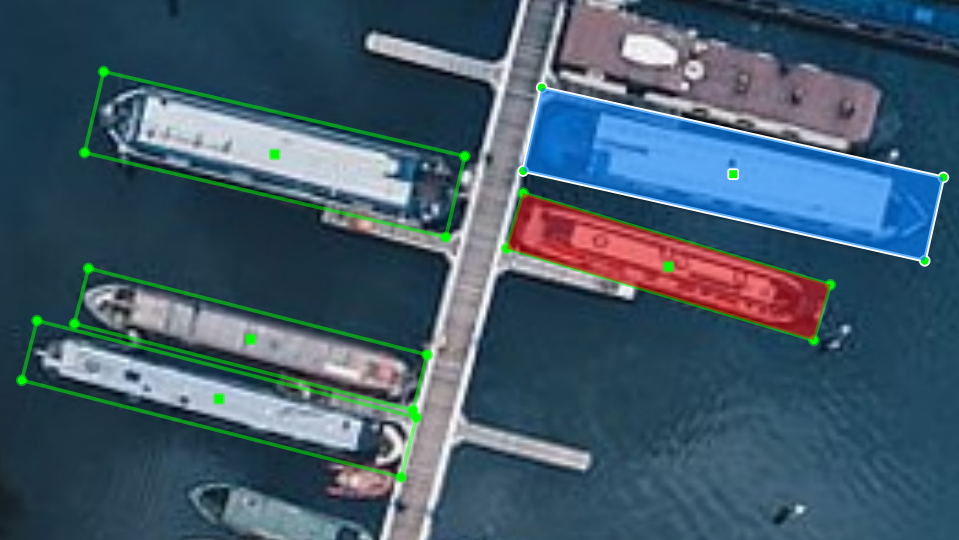
2.b Oriented Bounding box
For object detection in the above pictures, on the left (1.a & 2.a), horizontal rectangular boxes are drawn over the item, and on the right (1.b & 2.b), rotated (oriented) bounding boxes are used. The outcomes are readily apparent. While the oriented bounding box has no overlapping and the backdrop has been removed, the bounding box approach has overlapping problems and causes the target object to be contaminated. This illustrates how oriented (rotated) Bounding Box approach outperforms the conventional one.
Tools:
Some of the tools for oriented bounding box are listed below:
- roLabelImg Tool
- MM Rotate Tool
- Alpha Rotated Tool
- CVAT
A demo of the oriented bonded box technique using CVAT is available @ https://youtu.be/ar8mYFl2xWs
To summarize, the oriented 2D bounding box approach is described in this article along with an explanation of why it is better than the Bounding box technique. This technique is a boon for the researchers in their expedition as the potential for studying aerial imagery widens.
With our trained and experienced Data Specialists, there is never a compromise on quality. Contact us at info@haidata.ai for more information.
Frequently Asked Questions
Get in touch
For support and query:
Email us at info@haidata.ai
Ainnotate Data Technologies LLP
Prestige Tranquilty,
Budigere Cross,
Bangalore - 560049
Karnataka, India.
Sree Nagammal Bldg.
Manjoor,
The Nilgiris - 643219,
Tamil Nadu, India.




© 2026 | All Rights Reserved | Privacy Policy
HaiData is an AI Data solutions and services organization catering to the AI data needs of various industries. Started with the objective of contributing to "Data Centric AI", HaiData has invested in all aspects of the AI Data value chain - including services, technology and solutions. As an organization committed to providing jobs for technically qualified youth, who chose to work from rural places rather than cities, HaiData provides affordable AI Data related solutions and services to organizations across the world from the villages of Nilgiris hills, in India.